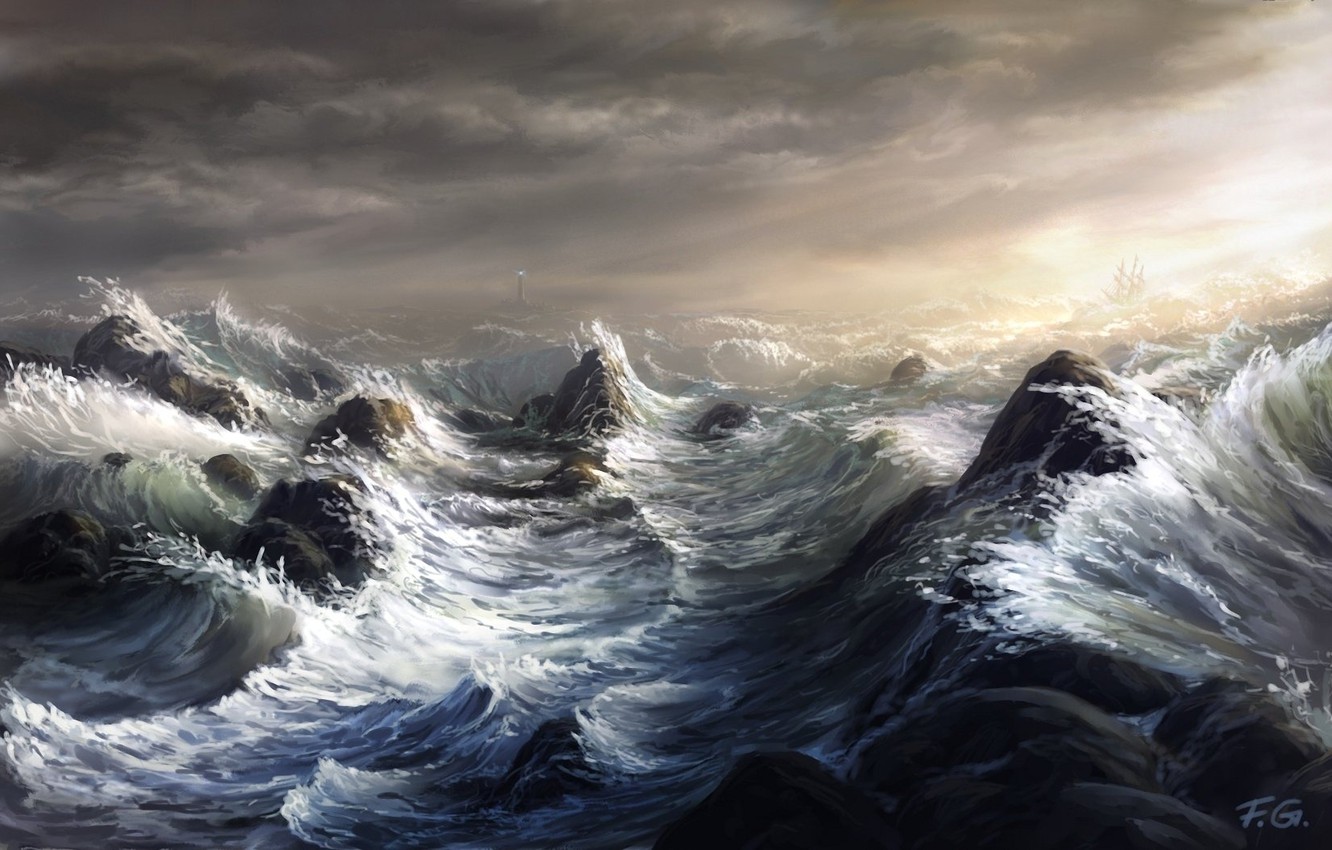
After several days of this monotonous chaos we spotted a very large ship approaching. They were rocking and rolling in their huge way, but not a wildly as we were. They made a slow approach and began several wide circles around us. They then began pouring oil into the water and we realized they were attempting to flatten the waves so we could abandon the yacht in our life raft. Jack said, “We’re staying on the boat…no way we’d survive in our flimsy life raft in these waves!” Then he yelled to me, the communications officer on the yacht, “Tell them we want a tow.”
The roar of the wind and their engines obviated yelling, so I grabbed the Boy Scout manual and a flashlight and proceeded to flash – “Dash / dash dash dash / dot dash dash”. After several repetitions, their signalman shot a rapid fire of dot and dash flashes none of which I got. So ever resourseful, I jury rigged two signal flags and jumped to semaphore with pretty much the same results. While continuing to screw around in this manner, I was suddenly joined by Barbara with a large white sheet upon which she had spray painted in large red letters, “TOW”. (This was the beginning of my realization that tho women clearly thought and reasoned differently, their insights and reasoning was to be sought and respected}
The Bogong’s crew acknowledged our message and prepared to send us a tow line. While this was all transpiring their bridge lost track of our relative position and suddenly we were pointing directly at her. The next wave caught the boat and drove her directly into the carrier’s side with such force that our bow sprit snapped, literally, like a match stick.
The bow sprit extends out from the bow at deck level. It is held in place by the forestay attached to the mast and the bob stay attached to the bow at the waterline. Its main purpose is to provide forward tension and stability to the mast. It works in conjunction with the back stay or in our case running backstays and the shrouds which support the mast on the starboard and port sides of the vessel. Each shroud has a piece called a spreader which is attached to the mast and forces each shroud further away from the mast. The result is that the mast, seated on the keel, is held in position by these four pieces of rigging.
Colliding with Bogong spun Ta’aroa, our starboard to her port and with each wave banging down her side. As we proceeded crash down along her side, I was standing on the starboard deck with Barbara, who was still holding the sheet, both of us trying to assess our situation and determine what we should do next. The Bogong had her screws slowly turning to maintain steerageway and we were quickly moving back toward her stern. Because of the shape of her stern, we were moving under her and our mast was beating against her side. One wave drove the mast against her and snapped the starboard spreader. Suddenly our fifty foot mast, now being deprived of two of its four means of support was virtually balancing on the keel with only the decking holding it in place. To add to the drama, we were now at Bogong’s stern and when a wave lifted her, her dual props were splashing a lot of ocean on to us. Barbara and I shared a glance which assumed we would be cut in half and which part would be the best to be on. I heard a shout from above. One of their crew saw our predicament was yelling to the bridge. A moment later both screws accelerated and to kick her stern away from us and for the moment out of danger.
Bogong stood off for a moment while they prepared for the next act.
At this point, one of their hearties should have grabbed a line and thrown it to us to commence with the towing. They, however, apparently had a new device which would shoot a metal projectile with an attached line to us and they were finally going to get a chance to use it.
Their initial attempt had the metal piece crash around the bridge with crew diving and running about to avoid getting hit. The second, badly aimed and with the gusting winds, missed us by some distance. The third, same result as the first. Finally, the fourth attempt wrapped the line around our mast. We grabbed it and pulled the much thicker line and then a very thick hawser on board and attached it to our bow. We gave them the go ahead and they started off.
Clearly the captain had spent some time driving a water-ski boat and wanted to make up some lost time. Don’t know how fast he was going, but we were crashing thru waves that were still huge. With great trepidation, we watched our mast, held vertical only by the decking, move around in a very unsettling manner. So, Jack gave an order, “If you have to go out on deck, do not use your safety harness!” The reason being that with the mast flailing around, should it come down, you couldn’t be screwing around trying to detach your harness to get out of the way. It also meant, should you lose your balance and start to go over the side, there was nothing to keep you on board. The last thing you would see is the sterns of both vessels as they disappeared at an alarming rate and you had not many moments to consider the life you had led and were about to depart.
Shortly after I had given our first Mayday transmission, Jack put on his sea lawyer hat and ran over the laws pertaining to boat salvage. Apparently, a Mayday call means we are about to die – please save us, our possessions and the boat are yours. However, if you throw a line to the towing vessel, or not having an adequate towline yourself, offer to buy to buy the one they throw to you, means you weren’t in that dire set of straits and they weren’t really saving your lives, merely giving you a friendly tow. There was no way to go thru all that song and dance when the Bogong appeared, but when a while later a shrimp boat appeared and then pulled alongside, Jack yelled over thru the still raging wind and rain, “What are you guys doing out here??” They gave him a very funny look and indicated they had monitored our several Mayday calls and had spent the last several days motoring out to give us hand. At that point, we detached the Bogong’s hawser from our bow; retrieve the towing line from this new vessel and rig it to our bow with the boat still climbing and crashing over huge waves. (NB: Just prior to our pickup, they were recording wave heights on their depth sounder that were running about 30 feet with one at least 35.) So, Jack never got to ask them if he could buy the towing line.
By now night had come upon us, which meant we had the relief of not being able to see the size of the waves, but could still feel them. These folks had a lot better idea of how to tow I rough weather, but we were still going way too fast, they were not aware of the unsupported mast.
With all the noise produced by the wind and waves, it took a while to realize there was an occasional loud pounding on the port bow. “OK”, Jack said to me, “Let’s see what’s going on.” I really didn’t want to, but knew we had to. This was my sixth day on a round-the-world yacht and I was beginning to wonder about the lack of romance.
Up on the bow, we realized we had a serious problem. The bow sprit which had snapped off when we careened into the Bogong was still attached to the forestay and the bob stay and occasionally when the wave pattern was just right, the eight foot long piece of solid mahogany was being driven directly into our port bow. One lucky shot and we’d be breeched.
So our job was to time the waves and the pitch of the boat and attempt to wrestle the broken piece onto deck. Once there, secure it – problem solved. We nearly had it several times, but the waves always clawed it back. Finally, exhausted, we gave up and tried to signal them with our torch to get them to slow down. Unfortunately, they had us on a long line and the waves kept getting in the way, even if they happened to be looking back.
Now on the bow with the torch and not holding on, we suddenly came off an exceptionally large wave and I was airborne. Without my lifeline, I was no longer connected to the yacht which had dropped totally out from underneath me. A moment later, she went into a trough and Jack, also untethered, reached up and grabbed me and I came crashing down on top of him, causing him some injury to his wrist, which he wasn’t aware of until the adrenaline wore off some time later.
Jack said, “Fuck this!” and we quickly, but cautiously crawled back into the cabin.